
Should I use an AI browser? Maybe?
I thought AI-enabled browsers would be a big thing, but they haven’t turned out that way. At least not yet.

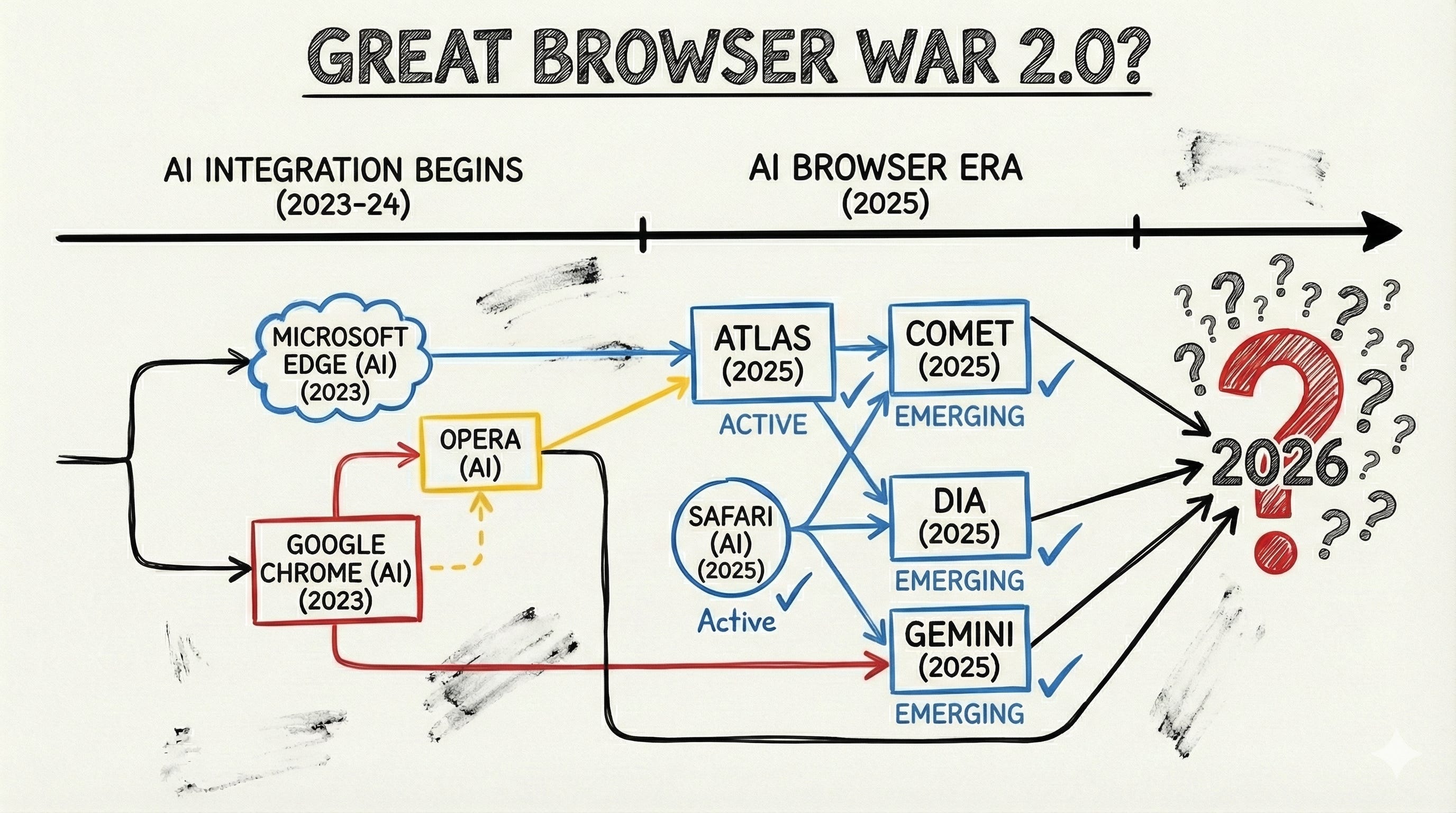
TL;DR: AI-enabled browsers are currently in a "wait and see" phase because they lack the life-changing utility and clear privacy standards found in other tools. While the hype died down in 2025, expect a potential breakout in mid-2026 as giants like Google and Microsoft refine their platform integrations.
Let’s talk about AI-enabled browsers and whether you should use one or not. If you live in the U.S., and you use Chrome, Gemini is enabled for you. If you use Gemini in Chrome, can tap into a lot of things—tabs, Gmail, Calendar, Drive. I’ve seen some examples that look really amazing and do some cool things while you’re browsing, helping you gather information, connecting the dots between things, and I expect it will only get better. If this week’s Gemini and Gmail updates are any indication, Google is taking a “slow and steady wins the race” approach with AI tools and features.
If you use Edge, and you are in the Microsoft 365 world, Copilot is integrated to Edge. Neither of those cases apply to me because I’m in Canada, I can’t use the Gemini features in Chrome and I don’t pay for Microsoft 365 (and I don’t want to use Edge) so the alternative is one of the myriad AI-enabled browsers that came out last year..
Everyone was excited about them. The potential for agents to help us do tasks. Gather information for us as we need it. Summarize long documents, collaborate more effectively. I don’t think it really turned out how people expected.
OpenAI’s ChatGPT Atlas, Perplexity’s Comet, Dia from The Browser Company, Brave, Firefox, plus a litany of other large players large and small, including Norton Utilities with its Neo browser. Norton Utilities, the one application that can take the most powerful laptop and bring it grinding to a halt with overloaded and bloated software.
But the question then is, if these AI-enabled browsers don’t seem to have lived up to the early hype and promise, is it still worth giving them a try? That’s a really good question.
I think it’s too early still
I’ll give you the TL;DR right off the bat—I think it’s still a wait and see situation. I’m anxiously awaiting for Gemini to come to Chrome outside of the United States. I think it’s going to be a really powerful and fantastic addition. It hasn’t appeared yet (as of January 11th), but what about all these others? Atlas, Comet, Dia, Brave, Firefox. are they worth it? Why is it wait and see? Here’s my thinking.
Will they work as promised?
First is utility. I haven’t seen since their initial launch any of the people I follow on LinkedIn, Substack, and elsewhere, talking about how much AI browsers have changed their life. I see and read about how ChatGPT or Grok or Gemini or Claude Code, any of those tools, have changed their lives. How AI tools have made them more productive, do amazing things. be more creative. I see that stuff almost every day. But I don’t see anyone sharing tips about how to get the most out of ChatGPT Atlas, Comet, Edge, or any of the other AI-enabled browsers. I think this is the most telling telling thing about the space.
The pivot from blogging as a personal platform to a business tool. We were building that in 2004-2005. Now it’s called “content marketing,” but then it was called “professional blogging.” I should know, I was one (Canada’s first I might add). People who were blazing a trail through there, were all talking about the tool and its potential to change everything.
And it did.
Twitter, going from its early days of just sharing thoughts and missives to what is now—something that almost every single brand you can think of has some presence on. We saw those signals early on with the same people. And, again, it changed everything.
I’m not seeing these same technological canaries in the coal mine sending me, or writing about, their top tips for using Atlas in their day. I’m not seeing new workflows using AI-enabled browsers. I’m seeing everything but AI browsers in the AI space. Writing, coding, video, research, writing, breaking new ground and creating new businesses. That’s what I’m seeing. I think if those browsers were that useful, those folks would be talking about it.
I’m seeing a lot of “yeah I downloaded it and trying it out,” then nothing. When the people at the edges of the adoption curve who are more than willing to put up with crashes, bugs, and half-baked features are giving a collective yawn. We should pay attention.
Dude, where’s my data?
I remember this coming up especially with browsers like Dia and Comet—privacy. If you are paying for ChatGPT, Perplexity, Gemini, there are some (some) protections in place. You would ostensibly use the browser logged into whatever AI account you use there and if you have additional protections turned on, you at least know what you’re getting into.
The problem with a lot of the AI browsers is they are tapping into OpenAI’s API to do AI-related things (queries, searches, summarization, etc.). Which is great for efficiency, not so great for keeping tabs on your data. There’s data that’s certainly tied to you as you go from browser session to browser session. What’s happening to that data? Where is it stored? How is it managed? How is it protected? Those are questions that weren’t terribly well addressed at launch and I don’t know if they have been ironed out enough for even the bleeding edge crowd to risk it. Privacy protections should (hopefully) become a lot clearer soon, but until then.
It’s a a whole “Dude, where’s my data‽” situation.
